The hidden cost of SKU proliferation
SKU proliferation is one of the most expensive and least visible problems facing packaging distributors.
There is an old saying that goes, “You can’t have everything. Where would you put it?” For packaging distributors who must constantly manage inventory, the reality of this joke is one they feel daily. SKU proliferation (aka bloat) starts small. A customer requests a custom envelope size. Another needs a cold pack solution. Soon, SKUs are multiplying like rabbits, quietly eating into margins and increasing logistics complexity.
SKU rationalization is often overlooked in packaging and dismissed as a more retail-focused technique. But rationalizing SKUs is more than crunching numbers. Sometimes it comes down to optimizing your offerings with converted film. This post will expand on this idea, as well as explore the risks of SKU bloat and the benefits of rationalization.
Why do distributors accumulate SKUs?
It is a story as old as sales: demand for a particular product goes up, so your inventory team stocks extra. But demand dies down, and perhaps it never comes back, leaving your warehouse shelved with dead products.
Other culprits of SKU bloat include:
- Uncontrolled customization: Allowing too many specific materials, sizes, or feature combinations to be ordered, leading to an explosion of unique SKUs.
- Market over-extension: Stocking products intended to serve too many distinct and small-volume packaging applications, often in an effort to compete in every niche.
- The “safety stock” trap: Maintaining unnecessarily high inventory levels of a broad range of standard and custom items due to fear of not meeting immediate or unpredictable customer demand.
In the moment, any one of these approaches can feel like responding to customer demand or managing a supply chain. But left unchecked, SKU growth can accelerate exponentially, diluting focus on your core offerings.
Also read: Six Timesaving Tips to Increase Warehouse Efficiency
Converting as a function of SKU rationalization
SKU rationalization is the process of eliminating redundant SKUs and optimizing stock levels. While the process will be slightly different based on each distributor’s customer base and inventory needs, generally, the process follows four broad steps:
- Auditing: Evaluating the current product portfolio and SKUs.
- Analysis: Determining which SKUs offer the most ROA.
- Planning: Making decisions on which products to consolidate or eliminate.
- Execute: Implementing the planned changes and communicating them to customers.
Finding a converted film alternative to your current products might fall into several of these categories. For example, let us say that a distributor, during an audit, determines they have three SKUs for the same product. The distributor can reduce SKUs by using a converted film option that is both temperature- and UV-resistant (planning and execution) that meets the needs of multiple customers.
How converted film changes the model
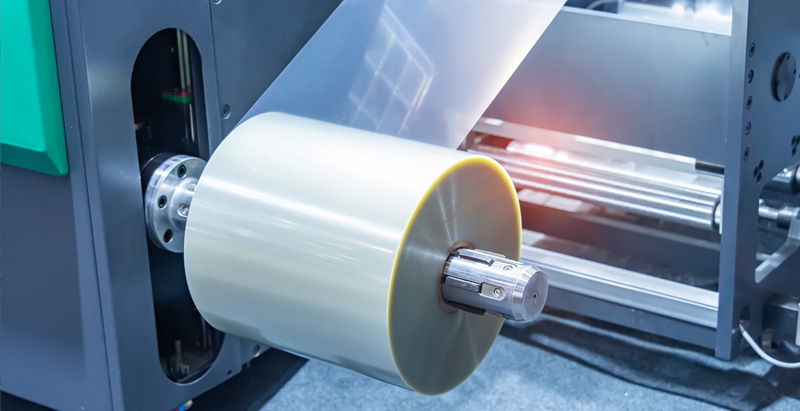
The most significant advantage of converted film is that it allows distributors to carry less raw stock. Converted film generally takes up less warehouse space than raw stock, helping optimize storage.
Other key converting features include:
- Slitting to width: Cutting large rolls of material into narrower strips of specified widths to meet customer requirements.
- Custom lengths: Specific lengths tailored to the customer’s particular needs, ensuring optimal use in their applications.
- Made-to-order rolls: This option enables the production of rolls of materials to individual customer specifications, allowing unique sizes and characteristics.
- Private labeling: This service allows customers to brand the packaged products with their labels, providing a personalized identity for retail or distribution.
- Master roll strategy: This involves a strategic approach to producing large rolls, optimizing the supply chain to ensure efficiency and cost-effectiveness for larger-scale projects.
Adherex Packaging has several strategic locations throughout the U.S. Paired with our stocking program, this allows us to meet the demands of distributors with low lead and shipping times.
Financial and operational benefits
Film converting can significantly bolster SKU rationalization efforts. Here are the key benefits to consider:
- Reduce warehouse expenses: Reduce the per-SKU warehouse space required by consolidating multiple applications into a single converted-film solution.
- Enhanced inventory management: Minimize stockouts and overstocks by aligning with customer preferences.
- Improved cash flow: Free up working capital by eliminating slow-moving stock. For example, if a distributor reduces 15 redundant SKUs and increases inventory turns by even 10%, the working capital impact can be significant.
- Increased operational efficiency: Reduce labor costs through streamlined picking and packing processes.
- Higher inventory turns: Accelerate turnover rates and decrease aging and obsolete inventory.
- Shift focus to high-margin products: Drive sales and profitability by prioritizing customer-tailored assortments.
When converting makes the most sense
When a single film could serve multiple functions, it is an ideal case for conversion and SKU reduction. For example, if you have food customers and currently have several types of film for food-touching products, one for fridge use, one for room temperature, and another product for labels. A converted film can meet all of those specifications.
Packaging with die-cut components, tabs, or specialized adhesives is another good application for converted film.
Additionally, when you need non-standard or custom sizes, it makes sense to seek help from a converter.
Also read: How High-Quality Printing Turns Compliant Food Packaging Film into a Marketing Asset
Partnering with the right converter
When choosing film and other multi-functional materials to replace SKUs, you need the insights of a team with years of hands-on experience. At Adherex Packaging, our material specialists can advise you on what is possible with conversion. We can serve as an integral partner for your SKU rationalization efforts.
If SKU complexity is limiting your growth or tying up working capital, our team can help you evaluate where converted film makes sense.